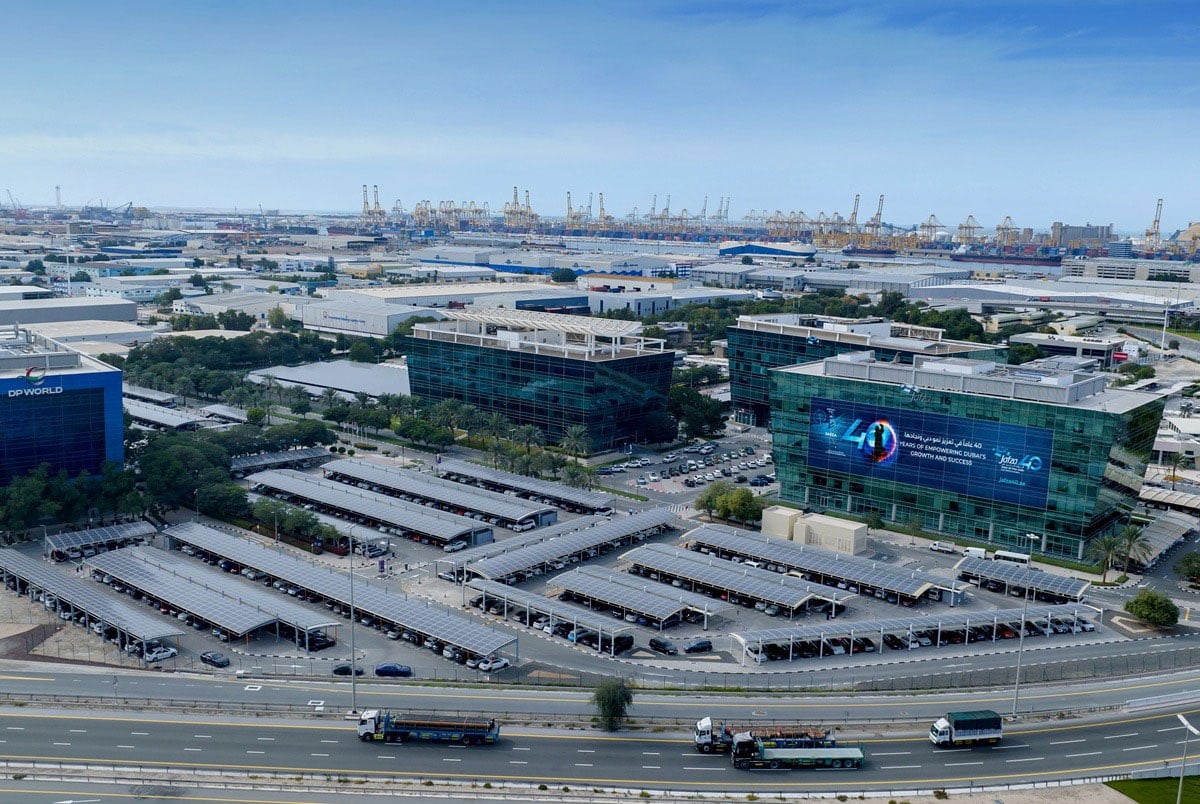
In global trade, the most important infrastructure is not always the largest port, the tallest crane, or the newest warehouse. Increasingly, it is the system that keeps critical goods moving when supply chains become uncertain. This is why the new automotive spare parts logistics center being developed in Jebel Ali Free Zone should be read as more than a property expansion. It is a signal that Dubai’s logistics economy is moving deeper into specialized, time sensitive, high value supply chains.
Hellmann Worldwide Logistics and Indu Group have announced the groundbreaking of a new facility of nearly 300,000 square feet in Jafza, designed to support faster and more efficient distribution of automotive spare parts across the GCC, Africa and other international markets. The project is being developed by Indu Logistics, part of Indu Group, as a dedicated automotive hub within Hellmann’s Middle East network.
The economic logic behind such a facility is straightforward but powerful. In the automotive sector, inventory is not passive stock; it is operating continuity. A missing component can stop a vehicle, delay a fleet, weaken after sales service, or disrupt a distributor’s ability to meet demand. As the region’s mobility market becomes more complex — spanning combustion vehicles, electric vehicles, commercial fleets and aftermarket platforms — the value of logistics shifts from storage capacity to responsiveness.
Jafza offers the kind of ecosystem that makes this model commercially viable. Its automotive, spare parts and aftermarket cluster spans 1.33 million square meters of combined facilities and includes more than 629 businesses from 70 countries, employing over 7,900 people. The free zone’s proximity to Jebel Ali Port, Al Maktoum International Airport, highways and multimodal links gives companies a platform from which they can serve regional and intercontinental markets with lower friction.
This matters because the Gulf is no longer only a consumer market for vehicles and parts. It is becoming a redistribution platform between Asia, Europe and Africa. Dubai’s advantage lies in converting geography into service reliability. The new facility strengthens that role by focusing on a segment where speed, accuracy and continuity have direct commercial consequences. For automotive brands, parts suppliers and distributors, the question is no longer simply where goods can be stored, but where they can be moved, cleared, tracked and delivered with the least operational uncertainty.
The partnership also reflects a broader investment pattern: global logistics firms are increasingly placing specialised infrastructure in Dubai because generic warehousing is no longer enough. Hellmann already presents the UAE as a strategic logistics hub for automotive original equipment manufacturers across the Middle East, Africa and Europe, with parts and component distribution anchored in Jebel Ali Free Zone. Indu Logistics, meanwhile, says its automotive warehousing services cover more than 200 product categories and operate around the clock, supported by large scale warehousing capacity in the UAE.
The strategic importance of the project is therefore not only in its size, but in what it represents: the industrialization of after sales logistics. Spare parts are often treated as a secondary activity compared with vehicle sales, yet they are central to customer trust, fleet efficiency and brand competitiveness. A market that can deliver parts faster becomes a market that can keep vehicles on the road longer, reduce downtime and support more sophisticated mobility services.
For Dubai, the facility reinforces a familiar but evolving proposition. The emirate is not competing merely on location; it is competing on the density of its logistics ecosystem. Ports, free zones, customs systems, warehousing, freight forwarding, road networks and specialist operators form a single economic machine. When that machine becomes more specialized, it attracts more complex trade flows and higher value corporate decisions.
In this sense, the Hellmann-Indu project is not just a new logistics center. It is part of Dubai’s transition from being a gateway for goods to being a control point for supply-chain performance. In a world where disruption has become a permanent business condition, the ability to move the right part at the right time is no longer a technical detail. It is a form of economic power.




Leave a Reply