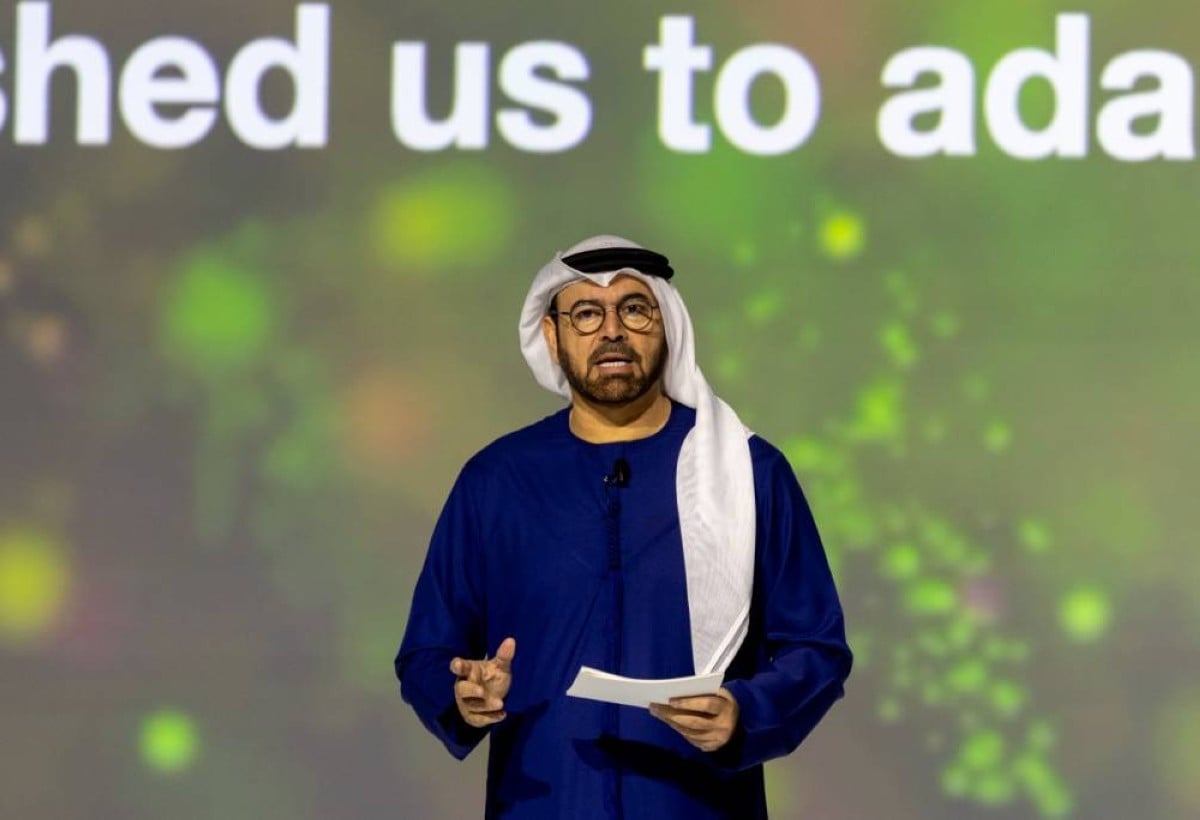
His Excellency Mohammad Abdullah Al Gergawi, Minister of Cabinet Affairs and Chairman of the World Governments Summit Organization, affirmed that the world today stands at a critical historical juncture that requires a complete redesign of the concept of governments, in order to keep pace with the profound transformation in human capabilities and the nature of human life. He emphasized that the real challenge is no longer merely keeping up with technology, but rather keeping up with the human being himself.
This came during His Excellency’s opening speech at the World Governments Summit 2026, which began today under the theme “Envisioning Future Governments”, and will continue until the 5th of February.
His Excellency presented an in-depth reflection on the journey of humanity within the broader context of the history of the universe, noting that the age of humankind, in comparison to the age of the universe, does not exceed “the last ten seconds.” Yet despite the brevity of this moment, it has witnessed profound transformations that have altered the course of human civilization.
Four Forces Driving Transformation
His Excellency Mohammad Al Gergawi outlined four main forces that form the core of this historic transformation:
1. Artificial Intelligence (AI):
His Excellency stressed that artificial intelligence is no longer just a tool; it has become a partner in thinking, analysis, and decision-making. He pointed to its growing role in various fields, especially medicine, where it can now detect and analyze things beyond the reach of the human eye. He noted that the future could see medical diagnoses relying entirely on AI. He also projected that the computing power of AI is expected to increase over the next decade by more than 800,000 times compared to its current capabilities.
2. Advanced Medicine:
His Excellency explained that modern medicine is no longer focused solely on extending human lifespan, but rather on extending healthy life expectancy. He noted the significant drop in the cost of sequencing the human genome — from around $100 million to approximately $600 today — with expectations of it falling below $100 in the future. This paves the way for personalized medicine and the early detection of diseases, possibly even during the fetal stage. He added that human life expectancy has doubled over the past 100 years, and is expected to double again over the next century.
3. Brain Sciences:
His Excellency said that the major discoveries of the future will not be in outer space, but rather in understanding the human brain. He emphasized that the integration of artificial intelligence with the human mind will redefine learning and cognition. He cited pioneering trials by companies such as Neuralink, which are developing brain-implanted chips to enable direct communication between the brain and devices, with some participants already able to control devices using thought alone.
4. The Digital Environment:
His Excellency pointed out that the digital environment has changed the concept of human identity and the rhythm of life. Today, over 5.5 billion people are connected to the internet, living in a globally connected world where they influence and are influenced. This has led to changes in attention patterns and the emergence of multiple digital identities for a single individual across different platforms.
A New Generation Driving Change
His Excellency emphasized that the convergence of these four forces has created a new human being, fundamentally different from the human of past decades — at a time when many governments still operate with systems and tools designed for the human of the past. He noted that Generation Z is becoming an increasingly influential pressure group on governments, with projections indicating that this generation will comprise around 40% of the global workforce by 2040. It is a generation that seeks balance, meaning, and lifelong learning, not just a job or a salary.
A Different Human
His Excellency reiterated that the convergence of these four forces is producing a human being entirely different from that of previous decades, while many governments are still relying on outdated tools and systems created for the human of yesterday — not the human of tomorrow. He stressed again that Generation Z is becoming a rising force, expected to account for about 40% of the global workforce by 2040, with a mindset oriented toward continuous learning, balance, and purpose.
A Historic Opportunity for Governments
His Excellency concluded his speech by affirming that history has shown that governments at critical junctures either lead transformations, wait passively, or fade away. He stressed that today presents a historic opportunity for governments to reshape themselves, based on the principle that their first and ultimate mission is to serve the human being. He warned that the greatest danger is not governments falling behind technology — but rather falling behind humanity itself.






Leave a Reply